GARDEN BASICS / HARDINESS ZONES
Read the tag.
Choose the spot.
A zone match gets a plant onto your shortlist. Follow one nursery tag all the way to a place in the garden.
You have found a shrub you like. Its label says USDA zones 6–8; your garden is 7a. That looks promising. It is enough to keep considering the plant, not enough to choose where it will live. 1
Turn the tag over before you reach for the trolley. The lines about light and soil are not fine print. They may decide whether this shrub belongs beside the house, farther out in the border, or back on the nursery bench.
FICTIONAL NURSERY LABEL
Example shrub
A teaching label, not a named plant
- 1 USDA zones
- 6–8
- 2 Light
- Partial shade
- 3 Soil
- Moist, well-drained
- 4 Mature spread
- 4 ft
All plant requirements on this tag are selected example inputs. Do not use them to identify or plant a real shrub.
ONE TAG, FOUR QUESTIONS
Read each line as a condition
Winter cold: is the garden within the listed USDA range? A full zone, such as 6, contains both 6a and 6b.
Light: does the planting spot offer the light the label asks for? The sunniest place is not automatically the best.
Water and drainage: can the soil stay moist without remaining saturated? Those are different conditions.
Room: can the grown shrub fit? The small plant in its nursery pot is not the size you are planning around.
The way to read the tag is grounded in Extension site-selection guidance; its particular numbers and requirements are illustrative. 2 8 9
What does 7a actually mean?
The 2023 USDA Plant Hardiness Zone Map uses the average of each year’s lowest winter temperature over 1991–2020. It does not show a record low, a forecast, or the temperature of an ordinary winter day. 1
Each full zone covers 10°F; the letters split it into 5°F halves. The a half is colder, the b half warmer. Zone 7 runs from 0 to 10°F: 7a is 0 to 5°F, and 7b is 5 to 10°F. 2 4
Use the rating for the exact species and cultivar on the plant you are buying. Arizona Extension notes that ratings can differ among sources because different organizations run the trials. If the tag and another reliable plant description disagree, take both to the nursery and ask which rating applies to that cultivar in your area. 4
KEEP THE MAP YEAR
Record the map edition with your zone. The 2023 update uses a newer weather period than the 2012 map, along with more data and improved mapping methods. A changed label does not mean the plants already thriving in your garden need replacing. 3 1
READ THE LABEL
Where does the garden fall?
Keep the example tag at USDA 6–8 and change the garden. Watch what passes the first screen—and what does not. Need your actual zone? Look up your location on the official map.
The label range is fictional. The USDA temperature bands are real. This is a range comparison, not a survival forecast. 2 4
EXAMPLE TAG · USDA 6–8
Pale cells: tag range · Outlined cell: garden
7a falls inside the tag’s 6–8 range.
The cold screen passes. Light, water and mature size still need a site check.
EXAMPLE · ZONE 7a
0 to 5°F
Average annual extreme minimum winter temperature
See the a/b halves
A colder year can fall below this band. The range describes a climate average, not a plant’s guaranteed survival limit.
All zone bands, in °F
| Zone | a · colder | b · warmer |
|---|---|---|
| 1 | -60 to -55°F | -55 to -50°F |
| 2 | -50 to -45°F | -45 to -40°F |
| 3 | -40 to -35°F | -35 to -30°F |
| 4 | -30 to -25°F | -25 to -20°F |
| 5 | -20 to -15°F | -15 to -10°F |
| 6 | -10 to -5°F | -5 to 0°F |
| 7 | 0 to 5°F | 5 to 10°F |
| 8 | 10 to 15°F | 15 to 20°F |
| 9 | 20 to 25°F | 25 to 30°F |
| 10 | 30 to 35°F | 35 to 40°F |
| 11 | 40 to 45°F | 45 to 50°F |
| 12 | 50 to 55°F | 55 to 60°F |
| 13 | 60 to 65°F | 65 to 70°F |
These are map legend ranges, not temperatures measured in your garden. Celsius results use (°F − 32) × 5/9, rounded to one decimal.
Three gardens, the same tag
5b
Below the cold end
The example tag begins at zone 6. A 5b garden is outside that rating. Treat the plant as a deliberate cold-risk trial, or look for one whose listed range includes the garden.
7a
Inside the range
The first screen passes. Keep the plant on the shortlist and examine the site. “Inside” does not mean every winter or every planting spot will suit it.
9a
Beyond the warm end
The label stops at 8. A milder winter does not make 9a an automatic yes. Check the plant’s full climate needs and local performance; the zone alone cannot diagnose why the range ends there.
These are fictional buying decisions based on label inclusion, not estimates of survival odds. Summer conditions also matter. 1 4 9
BACK TO THE 7a GARDEN
One matching zone. Three very different spots.
Now carry the same tag into a fictional garden. These notes combine a winter frost walk, a look after rain and summer observations. The illustration locates the three places; it does not supply the measurements.
Keep the tag in viewUSDA 6–8Partial shadeMoist, well-drained4 ft spread
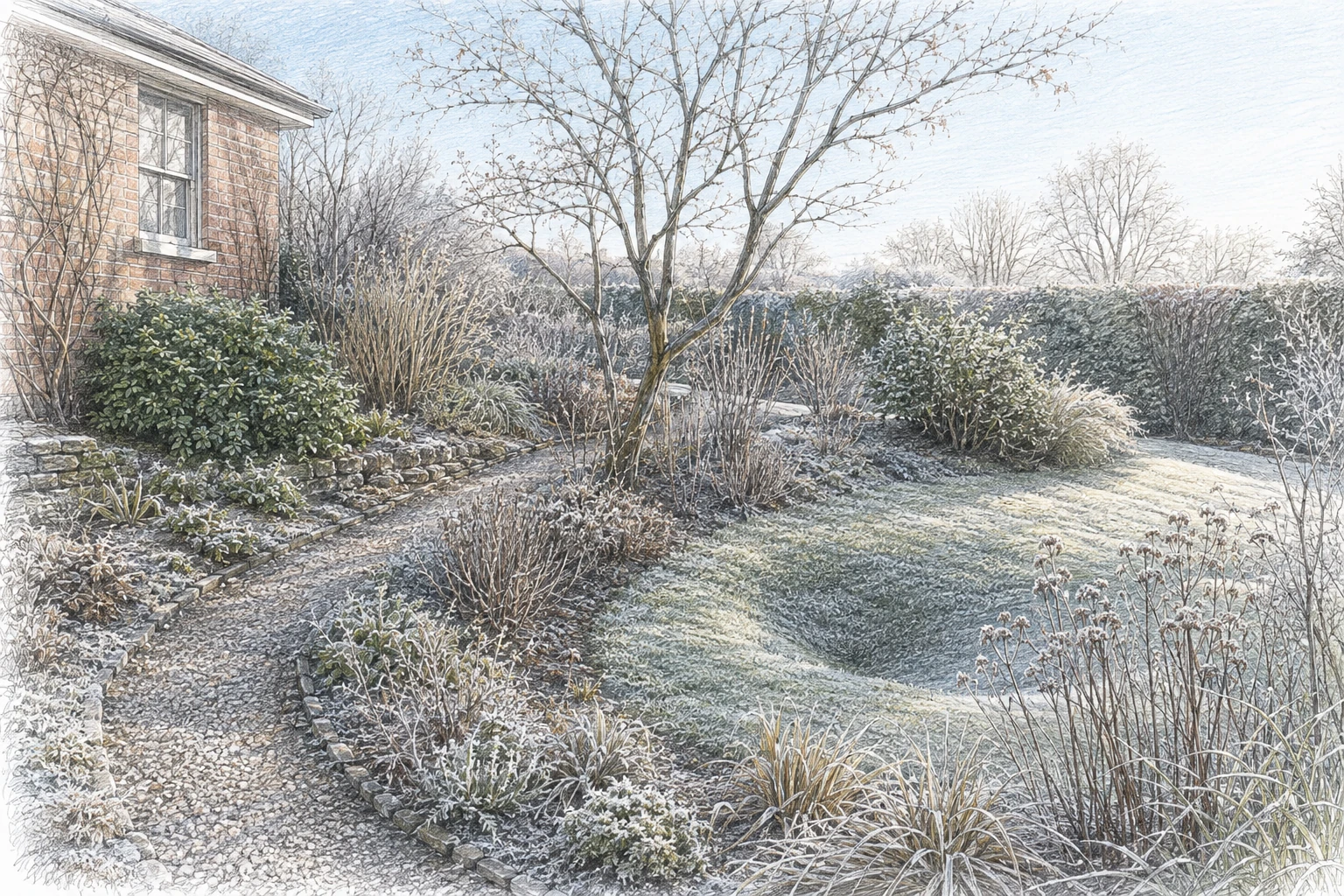
A WALL BED
Sheltered, but too sunny for this tag
The example note: south-facing wall; full sun in summer; soil dries quickly; sheltered from the prevailing wind.
The decision: set this spot aside for the example shrub. Shelter does not cancel its partial-shade requirement. A sun-tolerant plant could make better use of the place.
B MIDDLE BORDER
The candidate worth checking
The example note: morning sun, afternoon shade in summer; moist soil without surface puddles after the observed rain; room for a 4-ft-wide shrub.
The decision: keep this spot on the shortlist. Check drainage below the surface and confirm the cultivar’s needs before buying. No puddle is useful evidence, not proof of good drainage.
C LOW HOLLOW
A water question before a cold question
The example note: frost lingers here; water remains after rain; the ground is partly shaded.
The decision: do not choose this spot for the example tag’s well-drained-soil requirement until the wetness is understood. Investigate it, or choose a plant suited to wet conditions.
A warmer place can still be the wrong place
A low spot can collect cold air; a sheltered south-facing wall can create a warmer pocket. Even the current map cannot resolve every small difference in a yard. 1
Drainage is a separate mechanism. Roots need oxygen in soil pores; poorly drained soil can hold plenty of water while providing too little air. That is why “moist” on our example tag is not permission to plant in a puddle. Minnesota Extension recommends investigating each planting site, because soil can differ across a property and with depth. 8
For the middle border, take a photo of the whole setting, note when sun reaches it, and record what happens after rain. Include the date and season: a winter view under a bare tree does not document summer shade. Sketch the available width and compare it with the label’s mature spread. Planning for the grown plant helps avoid crowding a path or neighboring plants. 9
TWO DIFFERENT LOOKS AT WATER
In thawed soil, and not after heavy rain, Minnesota Extension suggests digging an 18-inch-deep hole, filling it with water and leaving it overnight. Water still there the next morning indicates a drainage problem. That test differs from the rainy-day walk: one notices where water gathers; the other checks a planting site under the specified conditions. 8
If the hollow is the place you need to fill, change the plant search first. Minnesota Extension offers choosing a wet-soil-tolerant species as an alternative to improving drainage. A different plant may be the smaller job. 8
THE COST OF AN EXPERIMENT
If a plant sits at the cold edge of its range, ask a local nursery or Extension office about that cultivar and your site before buying several. A rare cold snap can take a plant that has survived for years. For an expensive hedge or a long-lived tree, that is worth knowing before you dig. 1
A DIFFERENT NURSERY PURCHASE
The tomato starts ask a different question
Keep the garden at 7a. Replace the shrub in your trolley with tomato transplants for the summer vegetable bed. The zone has not changed; the decision has.
THE SHRUB
Can it stay for winters to come?
Read its perennial hardiness range, then match the site to light, soil and mature size. The plant remains outdoors across seasons.
THE TOMATO TRANSPLANT
Is the bed ready for it now?
For outdoor tomatoes, Minnesota Extension says to wait until frost danger has passed and soil has warmed. A winter zone cannot tell you that either condition is met today. Start with local crop guidance, the forecast and the bed’s actual conditions. 10
Look for local spring and fall freeze information. NOAA’s spring-freeze map uses a threshold of 32°F or below; its agricultural normals also describe growing-season length and other cold thresholds. These are historical guides. Check the forecast as planting approaches, because this year can differ widely. 5
A long season can still be a cool season
A frost-free season still needs enough warmth for the crop. Oregon State University gives a useful example: parts of the Oregon coast have a frost-free season similar to the Willamette Valley, yet can be too cool to ripen many tomato varieties. Winter survival and summer ripening are separate questions. 6
Think of two hurdles: avoiding damaging cold, and accumulating enough warmth to mature the crop. Clearing the first does not clear the second. In a cool coastal garden, ask which tomato cultivars ripen reliably there and whether that advice assumes outdoor plants or protection. In a warmer inland garden, the same cultivar and date may face different conditions. Bring your location, growing method and variety name—not just “zone 7.” 6
Overwintering vegetables bring winter cold back into the decision, along with crop, variety and site. West of the Cascades, Oregon State’s winter-vegetable guide pairs the relatively mild, rainy climate with full sun and well-drained soil. Use its crop-specific guidance for that region rather than treating a perennial zone label as a vegetable calendar. 7
Bring back a useful question
“Will this grow in 7a?” leaves a lot for the nursery to guess. A tag photo and a short site note make the conversation more useful. Separate what you saw from what you think it means.
Sketch where frost lingers and where the ground stays wet. Repeat the walk after other cold mornings. These notes can help you choose a site, but one morning’s pattern does not establish a new hardiness zone. 1 7
FILLED EXAMPLE · NOT A REAL GARDEN RECORD
Example shrub → middle border
- What the label asks for
- USDA 6–8; partial shade; moist, well-drained soil; 4 ft mature spread.
- What I know
- Garden 7a on the 2023 map. Morning sun and afternoon shade in summer. No surface puddles after the rain I observed. Space for the stated spread.
- What I have not established
- Drainage below the surface; exact cultivar and any additional soil requirements.
- My next question
- “Does this cultivar suit these conditions? What drainage check should I make before I plant it?”
- Decision for now
- Keep B as the candidate. Do not buy for A or C on the strength of the zone match.
Your own note can be shorter. Name the plant, keep the label’s wording, and make the missing check specific enough to answer.
TAKE YOUR OWN NOTE
One plant. Two possible places.
Record what is on the tag and what you have actually observed. Keep an unknown as an unknown; the note is useful precisely because it shows what remains to check.
Nothing is sent or stored. Download or print the finished note before leaving the page.
Your nursery note
About this editorial preview
Independent AI evidence review completed September 6, 2026; no human review claimed.
For your garden
Your saved garden details
Choose a garden and bed to see your saved zone and soil details alongside the guide. Missing details stay marked as not recorded.
Enable JavaScript to connect your garden. The article and sources are available without it.